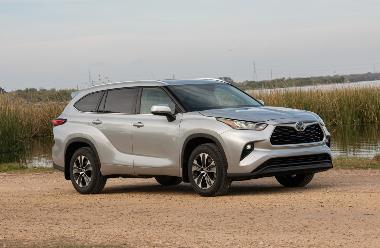
Toyota’s mid-size SUV, Highlander, has been redesigned from the ground up for 2020, as a fourth-generation sports-ute that brings new, bold styling, augmented safety and comfort, and a continued focus on durability and reliability, while adding a hybrid version to its gas-model line-up.
Highlander debuted in late 2000 as an innovative mid-size crossover that steered away from the prevailing truck-based SUVs of the time, with a more customer-friendly unibody structure and four-wheel independent suspension. Gaining in size over three generations, and adding a third row, Highlander has sold more vehicles than any other mid-size SUV since 2016, and was the second top-seller in the segment last year.
Among the changes for 2020 are a bigger overall structure and larger dimensions, a bold, sculptured new exterior design and a new vehicle platform called Toyota New Global Architecture, that has been created to enhance driving refinement, comfort and safety. Other new innovations include standard Android Auto, Apple CarPlay®, SiriusXM®, Waze and Amazon Alexa Compatibility and Toyota Safety Sense 2.0. The cabin is available with 7- or 8-passenger seating; there is increased cargo room behind the third row, an increased number of optional safety systems, and a choice of a gas-powered V-6 or a new-generation hybrid powertrain.
The 2020 Highlander begins with a powerful stance, chiseled lines and sophisticated detailing with a modern personality. Setting off the new design, the L, LE and XLE grades feature a black front grille with silver trim, while the Limited and Platinum grades are distinguished by a black grille with chrome trim and chrome-plated lower rear fascia, premium projector headlamps and Highlander’s first-ever 20-inch alloy wheels. The new Highlander gains in stature, and now measures 194.9 inches long (a gain of 2.4 inches), 76.0 inches wide (up 0.2 inches) and the same 68.1 inches high on a 2.4-inches longer 112.2-inch wheelbase, to provide 8.0 inches of ground clearance. Highlander weighs as much as 4515 lbs, but my test XLE trim came in at just over 4200 lbs.
The cabin is plush and premium-feeling. Details include softer padded surfaces and a more tailored look with stitching that continues from the door trim to the instrument panel. The 2020 Highlander cabin offers improved functionality throughout, from a center console that offers available Qi wireless charging to plenty of storage spaces and USB charging ports. Sound-damping and soundproofing materials have been optimized throughout the vehicle, for a very quiet ride for the niche. And my test XLE trim added heated front seats, a wireless smartphone-charging pad, and a power sunroof, among other interior amenities.
Somehow, the increased exterior dimensions yielded lost interior space for driver and passengers. The well-crafted and quiet cabin seats seven or eight, depending on configuration and now provides a tight 38.4 inches of front headroom (a loss of 1.1 inches), 39.4 in row two (down 0.2 inches) and 36.1 inches in row three (a gain of 0.2); leg room is 40.4 inches up front (a loss of 3.8 inches), a gain of 2.6 in row two to 41.0 inches, and the same child-worthy 27.7 inches in row three; with shoulder room of 59.0 58.7 and 55.0 (down slightly from last-gen). The lost space seems to translate to increased cargo space behind row three, to 16 cubic-feet, a gain of 2.2 cubic-feet over last year.
Available in 4-cylinder and V-6 powertrain configurations, the 2.7-liter 4-cylinder engine is coupled with a 6-speed Electronically Controlled automatic transmission with FWD, and with intelligence (ECT-i), sequential shift mode and snow mode. The system is good for 186hp and 175 lbs.-ft. of torque for an EPA estimate of 20mpg/city, 24mpg/highway and 22/combined.
The 3.5-liter V-6 engine that powered my test vehicle, delivers 295hp and 263 lbs.-ft- of torque, mated with a Direct Shift – 8AT, 8-speed Electronically Controlled automatic transmission with intelligence in either FWD or AWD, for an EPA fuel rating of 21mpg/city, 29mpg/highway and 24mpg/combined for AWD. My week of tests yielded an average of 24.7mpg in mixed-use tests.
Acceleration and performance were sneaky-fast, or faster than expected, with good response from a stop and in passing. Track tests showed a 7.2-second hand-timed zero-to-60mph sprint and a 15.5-second quarter-mile.
Available in LE, XLE, Limited and Platinum trims, as well as Hybrid trims, the gas-version Highlander starts at $34,600 for the base L and tops out with the Limited Platinum starting at $46,850. The Hybrids add about $3000 per trim. My test XLE based at a $39,600 starting price that included the 3.5-liter engine, 8-speed automatic transmission, FWD, Toyota Safety Sense™ 2.0 package, Qi-Compatible Wireless Charging, Moonroof, Heated Front Seats, Seating for eight, LED headlights and Daytime Running Lights, and Android Auto and Apple CarPlay compatible. In Blueprint exterior paint matched to a Black Softex interior, we upgraded to AWD for an additional $1600; and we added Premium Audio (six speaker and 8.1-inch touch-screen) with Dynamic Navigation for $1040. All-weather floor liners were $218; Body side moldings were $209; Door edge guards added $125; Chrome high Performance LED Fog Lights added $139; Rear bumper protector added $135; and delivery, processing and handling fees added $1120 for a sticker-as-tested of $44,186.
> Visit www.CarlisleEvents.com for more on the automotive hobby.
Mike Blake, former editor of KIT CAR magazine, joined Carlisle Events as senior automotive journalist in 2004. He's been a "car guy" since the 1960s and has been writing professionally for about 30 years. </I>
.tmb-thumb380.jpg?sfvrsn=ff138f72_0)
.jpg?sfvrsn=ff138f72_0)






.png?sfvrsn=8cce4cd8_2 "Parx Casino_Footer (125x125)")